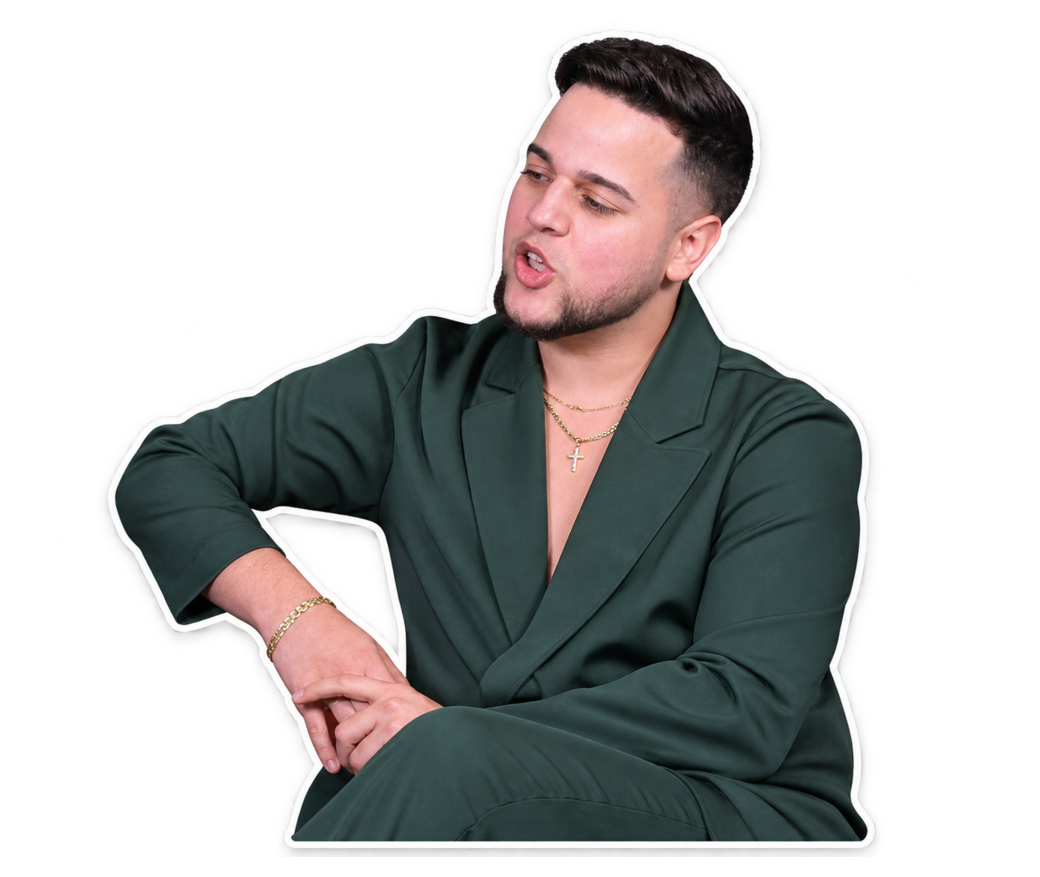
A clothing store and a phone
Engerson started creating content in 2022, which surprised even our hosts, because his name sounds like it has been around for much longer. Back in Venezuela he ran a clothing store. He is, in his words, extroverted in every sense, and when customers came in, he teased them with the kind of joking honesty that sounds like an insult and lands as affection. He would post videos of the exchanges with the people closest to him playing the role of customers, and, as he describes it, “it was like giving virtual slaps,” which people loved. The audience grew from there, and the phrase he coined, a sing-song “mi hijita,” was so widely repeated that our host joked he should charge a fee every time someone says it.
By the time he left Venezuela he had around two million followers on TikTok and more than 300,000 on Instagram, according to what he told us. Money in Venezuela, he explained, came mostly from live streams. Facebook did not pay for videos. It was in the United States that Instagram and other platforms began to pay him, and that brands began to hire him. The real income, he said, comes from outside the platforms: a brand that pays you to advertise.
The job nobody sees
Our hosts asked what it is like to be a creator, because it is easy to say that it is not a real job. His answer was about mindset. People will try to destroy you with a comment, he said, and some of those comments land. What he learned is arithmetic: if ninety percent of the comments are good and ten percent are bad, the ten percent cannot be allowed to end you as a person, or to make you quit. He described low days that happen to everyone. Then he reads messages from followers who tell him they were sad, saw one of his videos, and felt better. “It is a responsibility,” he said.
“It’s a responsibility.” — Engerson Urdaneta, on the messages from followers who say a video lifted them
The day the accounts disappeared
Then came the part that does not make the highlight reel. Engerson lost his accounts, the ones with millions of followers, and he lost the videos with them. He told us he had been in the United States for a year and a bit when it happened. It hit him hard. A friend in Orlando, he said, told him the thing that got him moving again: the content was him. It was his own voice shouting in those videos, and no one else had made them. He did not depend on anyone to make the next one. So he started from zero and began rebuilding, which is the part of his story that every small business owner with a social account should listen to carefully, because the lesson is practical: the audience you rent can vanish, and the skill you carry does not.
Crossing the jungle, smiling
His journey to the United States took him through the jungle, and he tells it the way he tells everything: with humor and without pretending that it was easy for everyone. He traveled with six other people, cousins and friends, he said, and people on the trail recognized him and asked for photos. For some of his group the trip was traumatic, he acknowledged. For him it was a matter of attitude: if he was going to be there, he was going to be smiling, and he made his cousins laugh. At the end of the first day, walking, he remembered praying and asking how long this would last. He also described the tension of the days afterward, when a group of fourteen split in two for an appointment slot and the other seven began screaming with joy when a booking finally came through. It is, he said, an experience nobody should have to live through, and many people lost family and friends on that road. Asked whether he would do it again knowing everything, he said that under the conditions he lived, he would.
Habits behind the numbers
The business half of the episode was a masterclass for anyone who sells through Instagram. He posts stories throughout the day, spaced about an hour or two apart, with polls and questions because every tap on a poll is an interaction the app notices. Brands, he said, ask for the last seven days of story views before they hire a creator. He also runs giveaways that require followers to comment, with the winner chosen by an app, which can bring several thousand viewers into a live broadcast, and the creator’s job is to make them want to stay. On TikTok, he explained, gifts from viewers can generate real income, but TikTok keeps about half of what a viewer sends. His next project, he said, is his own sportswear brand.
What brands should take from this
We are a media team that works with local businesses and Latino creators, so these takeaways are ours, drawn from listening to him:
- Check your product before you ask a creator to promote it. Engerson returns money when something looks wrong, and a creator who does that is protecting your brand as well as his audience.
- Pay for the audience’s trust, not just its size. His followers act on what he says.
- Plan for the unexpected. Accounts can be lost, and a creator with a repeatable skill recovers faster than one with a single platform.
- Treat the person behind the account as a person. He was candid with us about hate, low days and the responsibility to followers. Here is how we think about reading performance numbers.
If you own a local business and want neighbors to discover you, a creator can open that door. Here is how we have helped local business owners get seen.