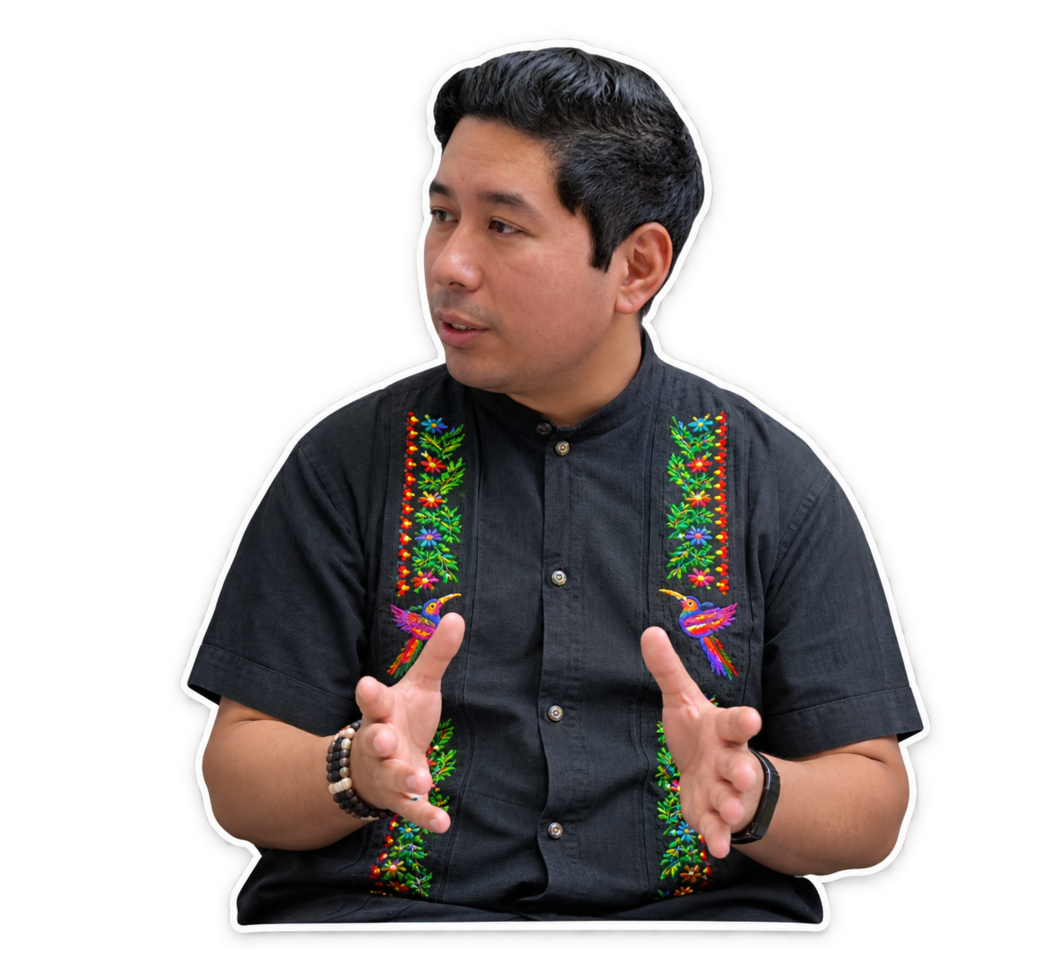
A boy in line at the food bank
Our episode notes describe Ricky Ruiz’s story as one of the most powerful and human we have heard on Aquí Entre Nos, and it begins in a very ordinary place: standing in line at a food bank with his immigrant parents. We recorded the conversation in Gresham, Oregon. What stands out about it is that the story does not skip over that line. Ruiz does not treat it as an embarrassment to be left out of the biography. It is where he starts.
Breaking a cycle
Ruiz talks about what it really means to break a generational cycle. He reflects on growing up in an immigrant household and on the moments that shaped his sense of responsibility. These are the moments when a child sees that his family is carrying something heavier than a typical family, and decides to carry some of it himself. It is a familiar pattern in our community, and it is why programs that support first-generation families matter so much. If you want to see what that support looks like in practice, read about Centro Mercado, a food pantry that works like a grocery store, in our article on how Latinos help each other.
Soccer as a lifeline
Soccer, he explains, became a lifeline: a discipline that kept him grounded and focused, and kept him moving forward when the odds were stacked against him. Anyone who has coached or raised a young athlete will recognize it. A team gives a young person a schedule, a standard, and adults who expect him to show up. In a household that might be short on all three, that can be the difference. The conversation does not turn it into a slogan. It simply notes that structure, mentors and belonging do work that policy alone cannot.
The weight of representing
The episode goes deeper than politics, as the notes put it. Ruiz speaks about the emotional weight of being a voice for the Latino community in Oregon: the pressure of representation, and the responsibility that comes with sitting at tables where families like his were never meant to be represented. He describes carrying the hopes, fears and dreams of an entire community while trying never to forget where he came from. The conversation covers immigration and identity, breaking cycles of poverty, representation and leadership, the power of community and mentorship, and what it truly means to serve.
“Carry the hopes, fears and dreams of an entire community, without forgetting where you came from.” — from the episode notes
What institutions can do
This section is our reading rather than the episode’s. Leaders do not appear from nowhere. They show up when a mentor notices a kid, when a program pays for a young person’s time, and when an organization listens to ideas from someone who is not yet old enough to be on the board. Cities, schools and health systems that want more community leaders can invite youth to speak, not only to attend; pay them for their time; and connect them to someone a few steps ahead. For ideas on bringing community voices into your work, read our guide to reaching Latino residents.
Directed by Héctor Mendoza, produced by Xiomara Mérida. Eliora Studio.